


Restructuring the cross functional team for growth and success

In today’s dynamic work environment, teams must stay flexible in working together. As new challenges arise, a manager is responsible for setting the team up for success by fostering an environment that encourages adaptability and innovation.
As a design lead, I recently spearheaded a significant project to restructure our design team to enhance collaboration, focus, and efficiency. The project emerged from our work on a complex product, where it became clear that a more strategic approach was needed to streamline our efforts and deliver high-quality results. I’ll share this journey’s key steps and insights in this case study, highlighting how we identified challenges, collaborated with senior product leadership, and executed a successful restructuring.

Identifying the Need for Change
Our team was engaged in a multifaceted project that demanded high coordination and strategic thinking. However, as the project progressed, it became apparent that our current structure hindered our ability to work effectively.
Designers were overwhelmed by the scope of their tasks, as they were working on multiple projects simultaneously. This meant collecting requirements, gathering feedback, and conducting workshops posed a significant challenge. Additionally, under the current structure, designers weren’t given the right level of accountability for their projects, leading to a low sense of ownership. This lack of ownership created a dynamic where designers felt disconnected from their projects.
Product managers also faced challenges in maintaining a cohesive vision across the project due to constant context switching between problem spaces. Another significant challenge was the time investment required from me in organizing and coordinating design reviews, which hindered my ability to lead the team strategically. This operational focus prevented me from dedicating more time to collaboratively developing a future vision and roadmap with the team.
Recognizing these pain points, I embarked on a process of investigation and introspection to understand the root causes of these challenges.
Interviewing and Synthesizing Insights
I interviewed team members to understand the issues comprehensively to gather their perspectives. I wanted to get an understanding of their specific challenges and what ideas they had to solve those challenges. I wanted to know more about collaboration, requirements, delivery and communication This helped me in coming up with the right questions to ask the design team as well as the product team
The feedback highlighted several recurring themes, including a lack of dedicated support for designers and difficulties in coordinating design reviews within the larger cross-functional team. Additionally, it became evident that our current structure was causing inefficiencies and impeding our ability to deliver timely and cohesive solutions.
In other words, we were all stepping on each other’s toes, and there were no direct owners for the different work tracks.
Challenges for Product Managers
The restructuring also addressed challenges faced by product managers, who were experiencing difficulties due to excessive context switching. Despite identifying decision-makers within the product team, some product managers struggled to become experts in any one project. This led to delays in receiving valuable input from the product team, resulting in the need for extensive reworking of solutions.
Additionally, the product managers were generally knowledgeable about the product, but only a few deeply understood how the product worked and why previous decisions had been made. This created a risk for the team’s longevity, as without spreading the knowledge around and investing time in documentation, we ran the risk of losing internal knowledge if team members rolled off the team.
Moreover, the product management team faced a similar challenge to mine. Senior product team members were occupied with tasks that mid-level product managers could manage. This lack of empowerment hindered their effectiveness in their roles, as the focus was primarily on delivery rather than taking a more strategic approach to the product space.

Developing a Solution
When I joined the team, the team consisted of 3 designers, 8 product managers, and 4 dev managers, all working on the same project. This setup provided context for the challenges we faced in coordinating efforts effectively.
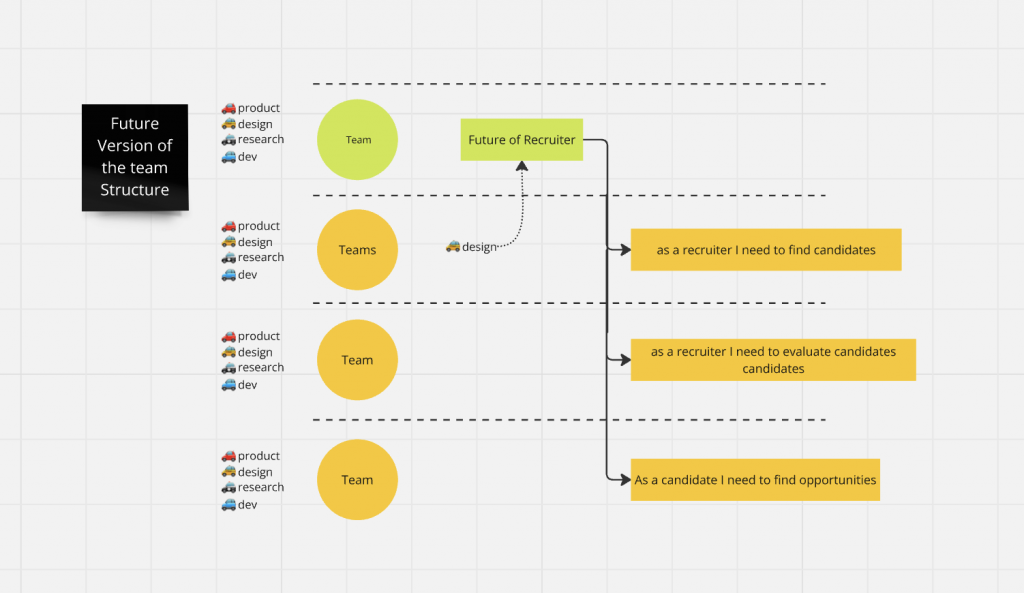
Before diving into the solution, discussing the ideation process is important. I designed several diagrams showing different ways the team could work more closely, considering time zones (US and CAN East, West, Central, UK, and Mauritius), expertise, and meeting cadences.
Armed with these insights, I formulated a plan to restructure the team into smaller, more focused pods. Each pod would follow the three-legged stool structure with its own dedicated product manager, designers and developers. This allowed for greater autonomy and alignment with the overarching project goals. This restructuring addressed the earlier challenges and created a more conducive environment for collaboration and innovation.
Additionally, through the design exploration process, we identified ideas that could serve as future enhancements to the team structure, providing a roadmap for continuous improvement that we plan to regularly revisit.

Executing the Restructuring
Implementing this restructuring involved two major challenges: breaking the larger project into manageable segments and gaining alignment from senior product leadership. To achieve this, I guided the team through a series of exercises where we examined the larger problem and started to draft user stories. After that, we aligned our users stories and problem statements with the cross-functional (xfn) team to collect feedback and make iterations. This process allowed us to define the scope of each segment and draft user stories, essential for breaking down the larger project into several smaller, more manageable parts.
Simultaneously, we engaged with senior leadership to secure their buy-in and support for the new structure, addressing any concerns and ensuring a smooth transition.
The project’s breakdown into smaller pieces required alignment from senior product leadership to split the larger project into several smaller projects and assign owners to each smaller project. However, this posed a significant challenge due to the company culture’s lack of support for this working model. We needed to provide some education on how agile cross-functional teams could function more successfully. At the same time we needed to discuss the potential risks involved in dividing the team. Additionally, we had to manage the logistics of adding several new ceremonies to the calendar while phasing out old ones.

Communication Strategy
Identifying a few core product and development team members who could become advocates for the new structure was key. Discussing and addressing their concerns was essential in getting this initiative off the groud. Getting these members to trust in a team structure that seemed very different from what they were used to required several conversations to ensure everyone was in a good place to accept and advocate for the changes.
Additionally, we needed to communicate the change back to the design team and provide the right amount of detail about the new expectations for how the team was meant to work together. Giving the designers a new level of ownership over their projects required creating assets that helped explain how they would work with the product team, development team, and design leadership.
Challenges
There were definitely mixed opinions about how successful the new model would be. Some concerns were raised regarding the domain knowledge of new product team members. To address this, we established biweekly design reviews where the entire team could review each other’s work, fostering a collaborative environment and ensuring knowledge sharing. This initiative led to discussions about the new ceremonies and the necessary requirements for each team to succeed.
Measuring Success and Iterating
With the restructuring in place, we established regular check-ins to monitor progress and address any issues. These check-ins provided valuable insights into the effectiveness of the new structure, allowing us to iterate and refine our approach based on real-time feedback. Over time, we observed several positive outcomes, including improved project estimation, more focused design workshops, and increased capacity for strategic planning. One outcome I hadn’t anticipated was that this also cleared a path to provide more in-depth mentorship and coaching with the designers on the team. With my role operating outside of the immediate deliverables I was able to coach the designers more effectively through the project, placing more emphasis on the quality and thoroughness of the deliverables.
Conclusion
In conclusion, restructuring our design team was a complex yet rewarding endeavor that required collaboration, adaptability, and strategic thinking. By identifying key pain points, collaborating with senior leadership, and executing a well-defined plan, we were able to transform our team’s dynamics and enhance our overall performance. This experience has equipped me with valuable insights and skills that I am eager to apply in future challenges, demonstrating my ability to effectively lead and manage complex projects.


